
Kauaʻi County Criminal History Checks
Begin with eCourt Kōkua when the goal is to find a filed Kauaʻi criminal case. Choose the Fifth Circuit where the search controls permit, search a complete name, and inspect the case identifier, charge history, events, and latest disposition. Public case metadata is free, while some filed documents require payment. Older District Court criminal records from before August 2012 and older traffic matters may require a courthouse inquiry.
Use the subject’s legal spelling, known aliases or former names, and date of birth only where an official interface lawfully accepts it. Hawaiʻi names may contain ʻokina and kahakō, while older records may omit them. A matching name is a lead, not identity proof. Compare the court result with KPD report information or a fingerprint-linked self-review when accuracy matters.
Search results can diverge for ordinary reasons. A prosecutor may amend the charge named at arrest, the court may not yet have transmitted a disposition to HCJDC, or KPD may retain the event under a report number before any Judiciary case exists. Try permitted spelling variants, but do not merge two people merely because their names resemble one another. The latest court disposition carries more meaning than the initial allegation.
- Search eCourt Kōkua for filed Fifth Circuit criminal cases and note the exact case ID.
- Check eCrim separately for public Hawaiʻi adult conviction information.
- Request the KPD incident or arrest report if the police event itself is needed.
- Use SAVIN/VINE or call KCCC for present custody rather than assuming a court entry proves location.
- Order a certified court copy or HCJDC check when an official document is required.
One Arrest, Four Record Systems
Kauaʻi has no elected county sheriff maintaining a public arrest portal. KPD processes the police event; the Department of Corrections and Rehabilitation manages KCCC; the statewide Judiciary files the case; and the Hawaiʻi Criminal Justice Data Center maintains the central criminal-history repository. The same event can therefore have a KPD report number, a custody identifier, a Judiciary case ID, and an HCJDC arrest cycle.
The sequence is not always simultaneous. Officers first document and process an incident, KPD may release or hold the person as authorized, prosecutors decide which charges to pursue, and the Judiciary creates the court docket. Disposition data must then travel back to the repository. A missing entry in one system can reflect timing or scope, so check the source best suited to the question instead of treating silence as proof that nothing happened.
| Police event | KPD report and arrest details; request through KPD Records. |
|---|---|
| Filed case | Fifth Circuit docket and documents through eCourt Kōkua or the clerk. |
| State history | HCJDC fingerprint-supported arrest and disposition information, with a narrower public eCrim product. |
| Custody | KPD holding, KCCC, and SAVIN/VINE status; not a finding of guilt. |
Official Background Checks in Hawaiʻi
The Hawaiʻi Department of the Attorney General’s HCJDC is the state repository. Its public Adult Criminal Conviction Information service, known as eCrim, is a Hawaiʻi-only name search. It excludes confidential pending and ordinary non-conviction arrest information, so it is not a complete national rap sheet. A fingerprint comparison is the stronger identity method because an arrested person may have used an alias.
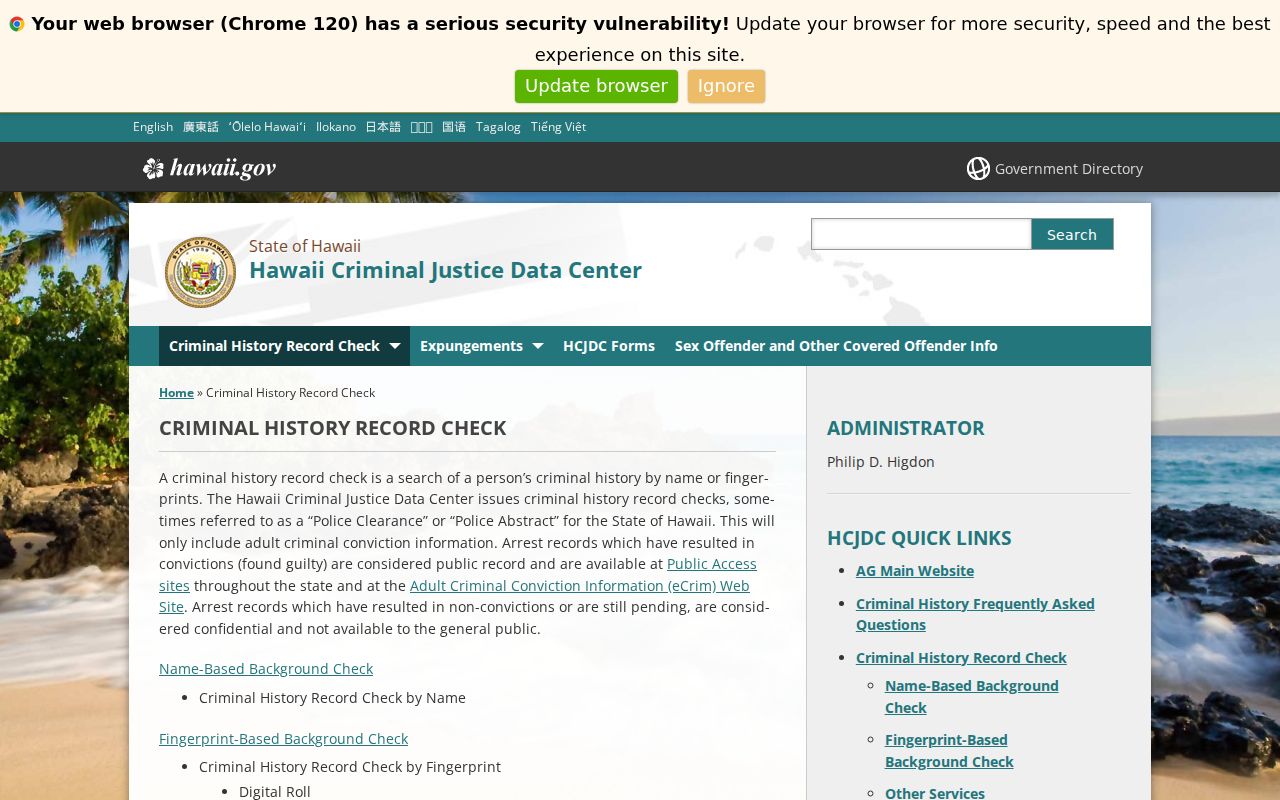
The HCJDC check-options page explains online, public-access, staff, and fingerprint routes. The captured official page below distinguishes the available state products. It helps a requester choose a name printout for public conviction information or fingerprint-based Access and Review for the subject’s fuller state record.
For a national self-review, the FBI Identity History Summary is separate from HCJDC and eCrim. KPD offers appointment-only public fingerprinting, but it directs clearance and criminal-history products to HCJDC.
HCJDC Fees and Kauaʻi Access
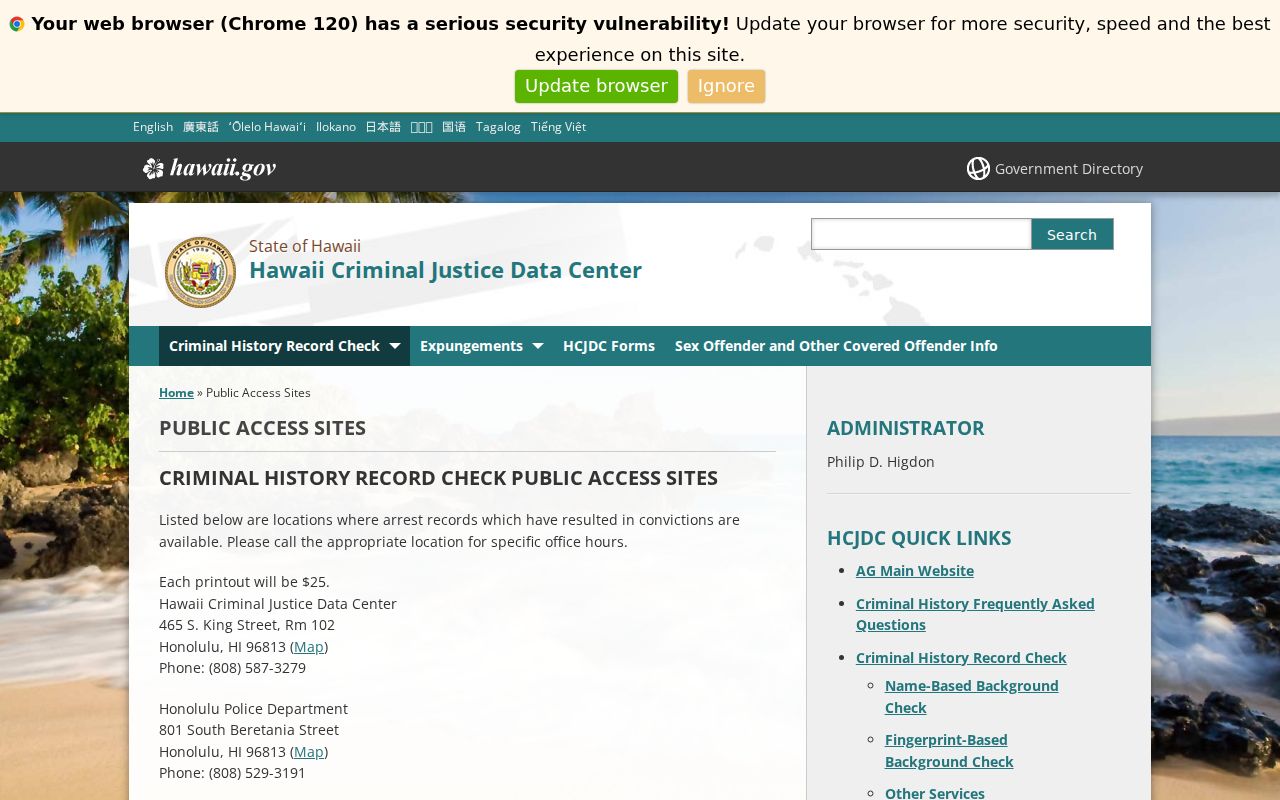
Kauaʻi’s listed HCJDC public-access site is KPD headquarters at 3990 Kaʻana Street in Līhuʻe. Call 808-241-1661 before visiting because local access hours can change. The official public-access list shown below identifies the Kauaʻi location; the county police station is an access point, not a separate county repository.
Published HCJDC prices vary by product and delivery route. Electronic payments at the Honolulu office add a nonrefundable three-percent service fee, and mail requests require a money order or cashier’s check rather than a personal check. Confirm the exact fingerprint combination because the form components and FAQ bundle some charges differently.
| Online name result | $12 printed eCrim result. |
|---|---|
| Public-access printout | $25 at a listed access site. |
| Staff name check | $30. |
| Fingerprint check | $55 in person or $35 by mail, subject to the selected service combination. |
| Certification | $20; rolling fingerprints are listed at $25. |
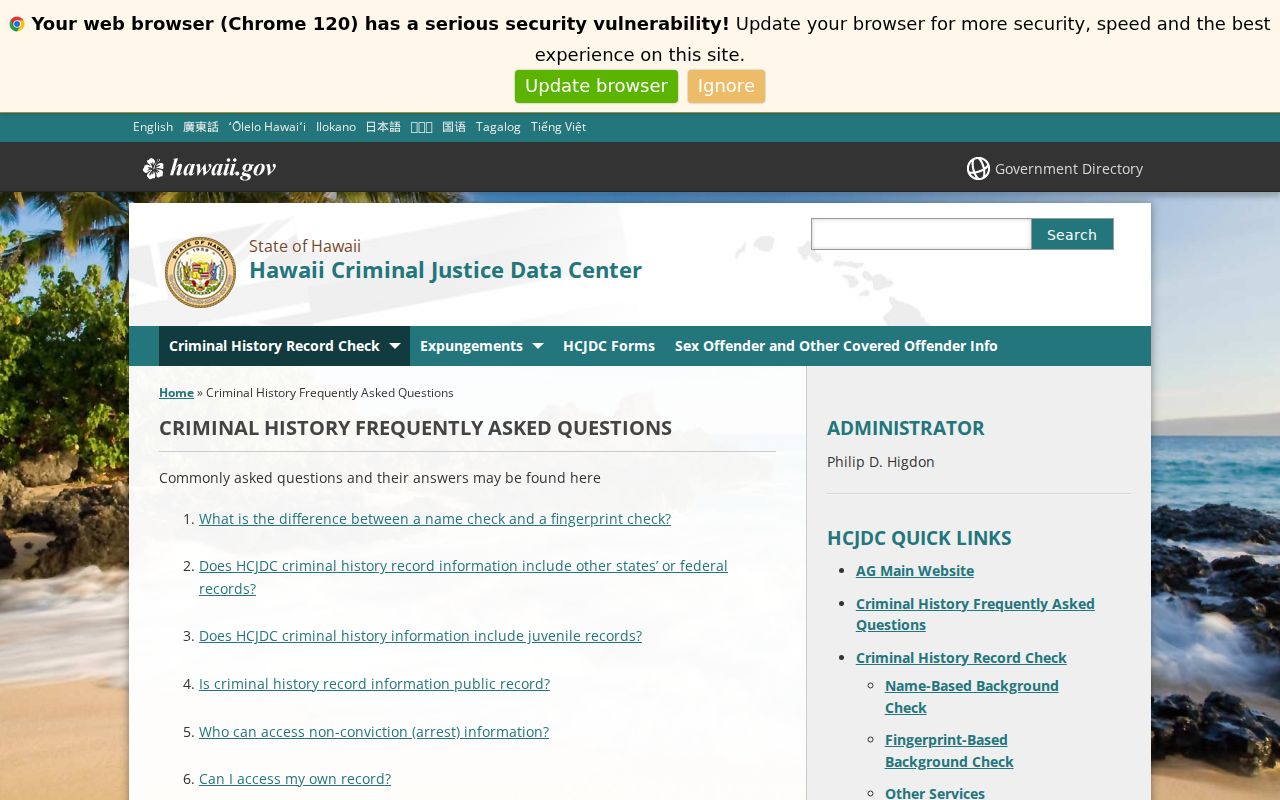
The HCJDC fee and FAQ page is the controlling source. Its captured view reinforces why a requester should price the precise service before mailing payment.
Keep the receipt and request type with the result. A paid name result and fingerprint Access and Review do not have the same scope.
Kinds of Criminal Records
“Criminal record” is a convenient label for documents created by different custodians. KPD incident material can exist without an arrest. A booking file records custody processing, while the court file shows what prosecutors actually filed and how the court ruled. HCJDC then associates eligible arrest and disposition information with an identity.
- Incident reports describe a reported event and investigative work, subject to privacy and active-case limits.
- Arrest and booking records document custody and alleged offenses; they do not establish guilt.
- Court files contain docket events, pleadings, rulings, dispositions, and sentences.
- Repository histories organize fingerprint-supported state arrest cycles and reported outcomes.
- Custody and registry records answer current status or statutory registration questions, not the final outcome of every case.
KPD Records Requests in Practice
KPD Records at 3990 Kaʻana Street, Suite 200, handles non-business requests for police reports. The request form asks whether the requester is involved, the requester’s name and contact details, the report number, incident date, type and location, and the involved person’s name. Identification is required, and pickup is arranged by appointment. Records staff may redact personal details or withhold active investigative material.
KPD says most reports become releasable after the investigation concludes and the case closes, but release is still subject to review. Its process includes a confidentiality review that can take at least 48 hours before staff release a responsive copy. Reports involving minors, sexual offenses, medical details, witnesses, or an ongoing investigation may require more redaction or a different access analysis.
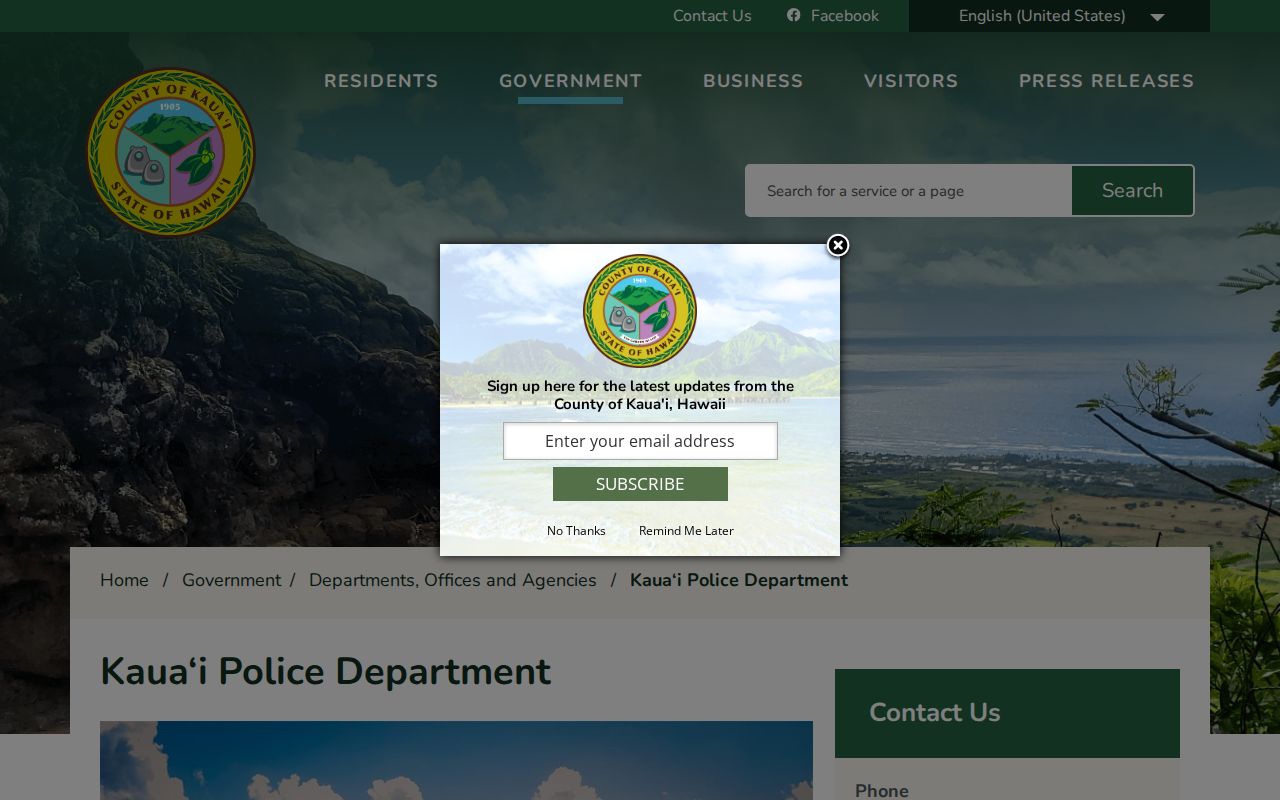
The Kauaʻi Police Department’s official page provides the agency context captured below. KPD is the islandwide county police department, even though detention, courts, and the criminal-history repository belong to state agencies.
Call the Records Clerk at 808-241-1929 or Records Supervisor at 808-241-1660 for process questions. Dispatch at 808-241-1711 serves immediate non-emergency police needs; it is not a report-copy counter. KPD’s temporary July–August 2026 service schedule should not be treated as permanent, so verify current hours.
Kauaʻi County Criminal Records: What They Contain
A full fingerprint-linked Hawaiʻi record can connect identifiers and aliases to the arresting agency, date, charges, court tracking, reported disposition, and sentence. A public eCrim printout is narrower. A free eCourt case header is different again from the filed document available for purchase.
| Name & Identifiers | Legal name, aliases, and identity details permitted for that product. |
|---|---|
| Arrest / Booking Data | Arresting agency, arrest date, alleged offenses, and processing identifiers. |
| Charges & Statutes | Initial or amended counts and Hawaiʻi statutory references. |
| Disposition | Dismissal, acquittal, plea, conviction, or another reported outcome. |
| Sentence | Court-ordered incarceration, probation, fines, or other terms where public. |
| Custody / Supervision Status | Separate DCR, SAVIN/VINE, probation, or parole information, which may have access limits. |
Puʻuhonua Kaulike and eCourt Kōkua
Kauaʻi belongs to Hawaiʻi’s Fifth Judicial Circuit. Circuit Court handles felony and other serious matters; District Court handles misdemeanors, petty misdemeanors, traffic matters, and authorized preliminary stages. There are no county or municipal criminal courts and no county clerk with a competing portal.
The Fifth Circuit contact directory shows Puʻuhonua Kaulike at 3970 Kaʻana Street in Līhuʻe. The captured directory below points readers to the proper statewide Judiciary offices rather than a nonexistent Kauaʻi county-court system.
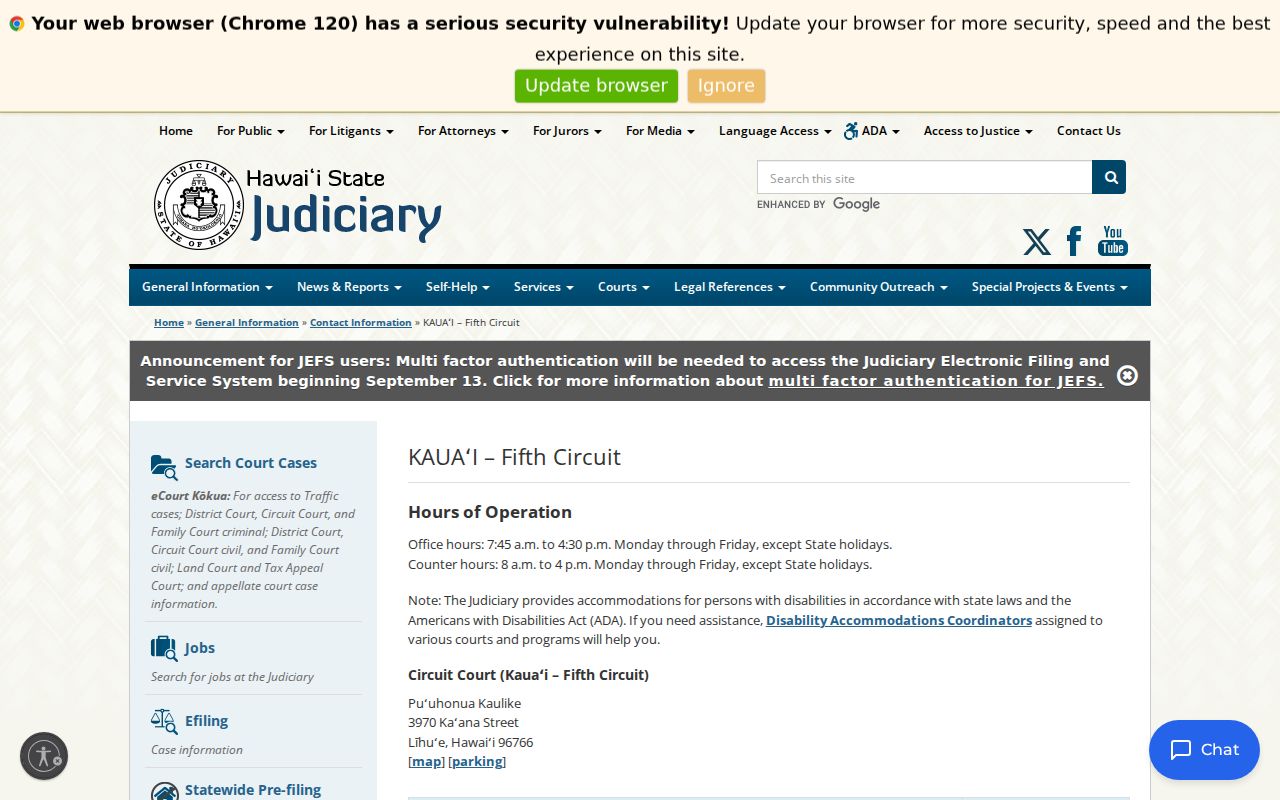
Judiciary office hours are 7:45 a.m. to 4:30 p.m.; public counter hours are 8 a.m. to 4 p.m. weekdays except state holidays. Call 808-482-2645 for the published criminal, traffic, and misdemeanor counter. Courthouse terminals generally allow free on-screen viewing. The general hard-copy schedule is $3 for the first 30 pages and ten cents for each added page; ask separately about certification.
An eCourt event line does not guarantee that the corresponding filing is downloadable. Use the document link when available, or give the clerk the exact case ID and document title. District criminal cases predating August 2012 and traffic matters predating November 1995 fall outside ordinary online coverage. The clerk can explain copy and certification mechanics but cannot interpret a ruling.
Hawaiʻi Public Access Laws
Hawaiʻi’s Uniform Information Practices Act, HRS chapter 92F, begins with an agency duty to disclose but also recognizes privacy and legitimate government-function exceptions. Criminal-history dissemination under chapter 846 and court access under the Hawaiʻi Court Records Rules add record-specific limits. “Public” never means every police narrative, birth date, witness statement, video, juvenile file, or sealed document is open without redaction.
Key Statutes:
HRS § 92F-11 — requires agency access to government records unless an exception applies.
HRS § 92F-13 — recognizes privacy and government-function exceptions.
HRS chapter 846E — governs public information about sex and other covered offenders.
HRS § 831-3.2 — sets criteria for expunging qualifying arrest information.
A Better UIPA Request
A useful KPD request identifies the report, incident or date range, likely office, and preferred electronic or paper format. Include a reasonable cost ceiling. If KPD withholds material, request the written statutory basis and any reasonably segregable nonexempt portion rather than asking only for an all-or-nothing release.
Specificity reduces avoidable back-and-forth. State whether the request concerns an incident report, dispatch material, a photograph, or another identifiable record, and distinguish inspection from a copy. Do not ask KPD for a court judgment it does not maintain or ask the Judiciary for a police narrative. Each office applies the law to its own records.
Hawaiʻi’s Office of Information Practices offers guidance and an opinion process. OIP Opinion F22-01, which concerned KPD records, illustrates that the status of an investigation can change the disclosure analysis and that redaction may replace complete withholding. Individual access to one’s own personal record under HRS §92F-21 is not identical to a general public request.
Restricted, Sealed & Expunged Records
HRS §831-3.2 permits expungement of qualifying arrest information, commonly after an arrest or charge that did not end in conviction, subject to statutory exclusions. HCJDC administers the application. The listed fee is $35 for a first expungement and $50 for a later application, each including a $10 nonrefundable processing component; a duplicate certificate is $20.
Arrest expungement and court sealing are separate. After HCJDC issues relief, a related case may remain visible through eCourt Kōkua until a written sealing request reaches the Judiciary and the court acts. Preserve the HCJDC certificate, identify every related court case ID, and verify both systems. Juvenile, confidential, and sealed matters are not shown through the ordinary public court search.
KCCC Custody and Warrant Limits
Kauaʻi Community Correctional Center is a 128-bed DCR facility at 3-5351 Kūhiō Highway. KPD may use its cell block before a transfer, but there is no official county sheriff roster. Search Hawaiʻi SAVIN/VINE by name or offender ID, then call KCCC at 808-241-3050 when coverage is unclear. An absent VINE result does not prove release.
No verified public KPD warrant database or official local inmate app was located. For a possible warrant, check public Fifth Circuit docket references, contact the issuing clerk with the case ID, or call the DCR Sheriff Division Warrants Section at 808-587-3632. KPD warned in February 2026 that it never demands phone payment for warrants or fines. Courts communicate officially by mail; cryptocurrency, prepaid-card, and money-transfer demands are scam signals.
SAVIN/VINE can show a name, custodial agency or location, offender identifier, and notification choices when the participating record supplies them. It is not a complete booking sheet and does not promise a mugshot, warrant number, bond breakdown, judge, housing unit, or court date. Call KPD’s cell block at 808-241-1632 for a short-term holding question and use the court docket for hearing information.
City-by-City Criminal Records in Kauaʻi County
Kauaʻi County has no incorporated cities or municipal governments. These guides cover the three largest 2020 Census-designated places—Kapaʻa, Līhuʻe, and Wailua Homesteads—without implying that any has its own police department or court. All three use KPD, Fifth Circuit, KCCC, and the county prosecutor, though the nearest counter and patrol district differ.
Kapaʻa Record Check
11,652 · Kawaihau District response, with reports copied centrally in Līhuʻe.
Līhuʻe Record Check
8,004 · Home to KPD Records, Puʻuhonua Kaulike, and the prosecutor.
Wailua Homesteads Record Check
6,680 · Līhuʻe District service with no local records counter or court.
Reading Kauaʻi Place Data Carefully
The 2020 Census place-data source supports the community ranking used for the local guides. Its captured resource below explains the official dataset behind those CDP populations, not crime rates or court caseload.
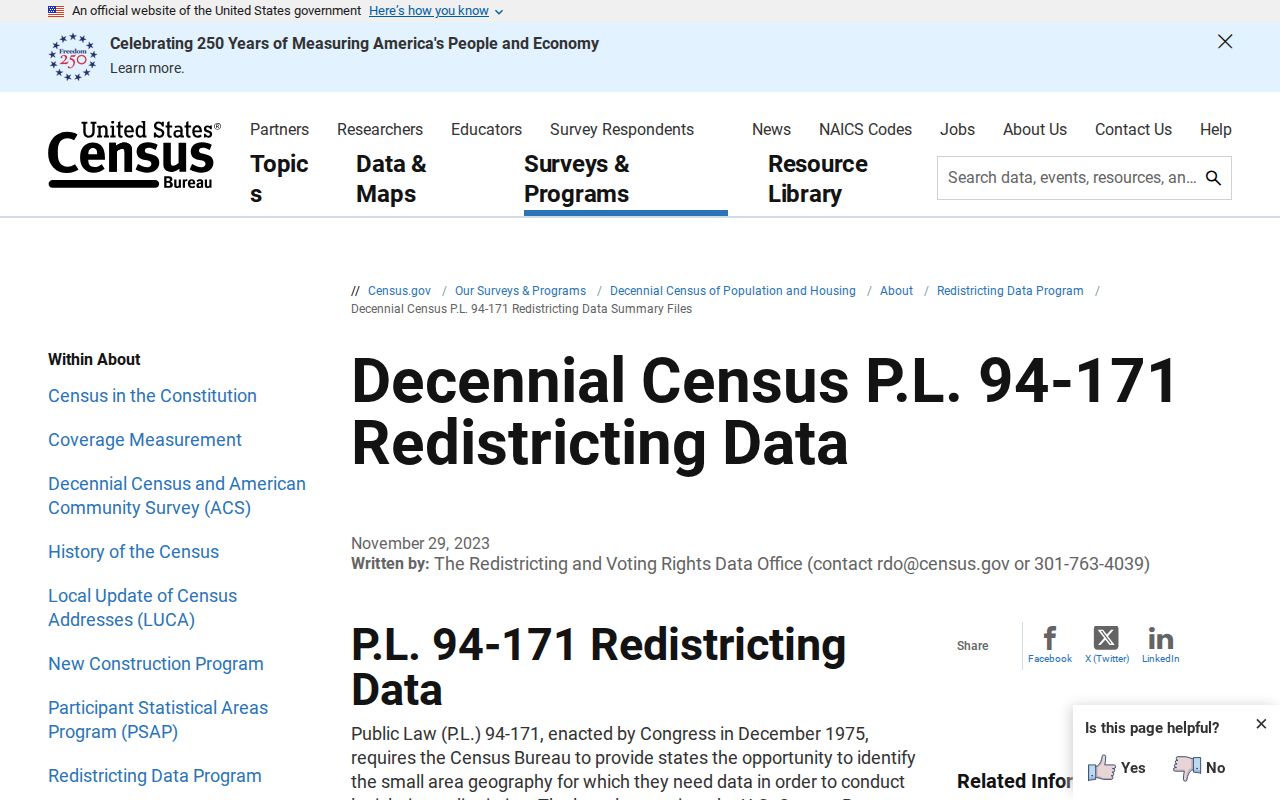
Countywide data should not be relabeled as Kapaʻa, Līhuʻe, or Wailua Homesteads statistics. A police report location, postal place, Census boundary, and court party address may also use different place language. Search by a person’s verified name, report number, or case ID instead of treating a neighborhood label as a unique record key.
The Kauaʻi County QuickFacts page provides broader county context in the captured view below. It is useful for scale, but it does not turn a county statistic into evidence about any individual or community.
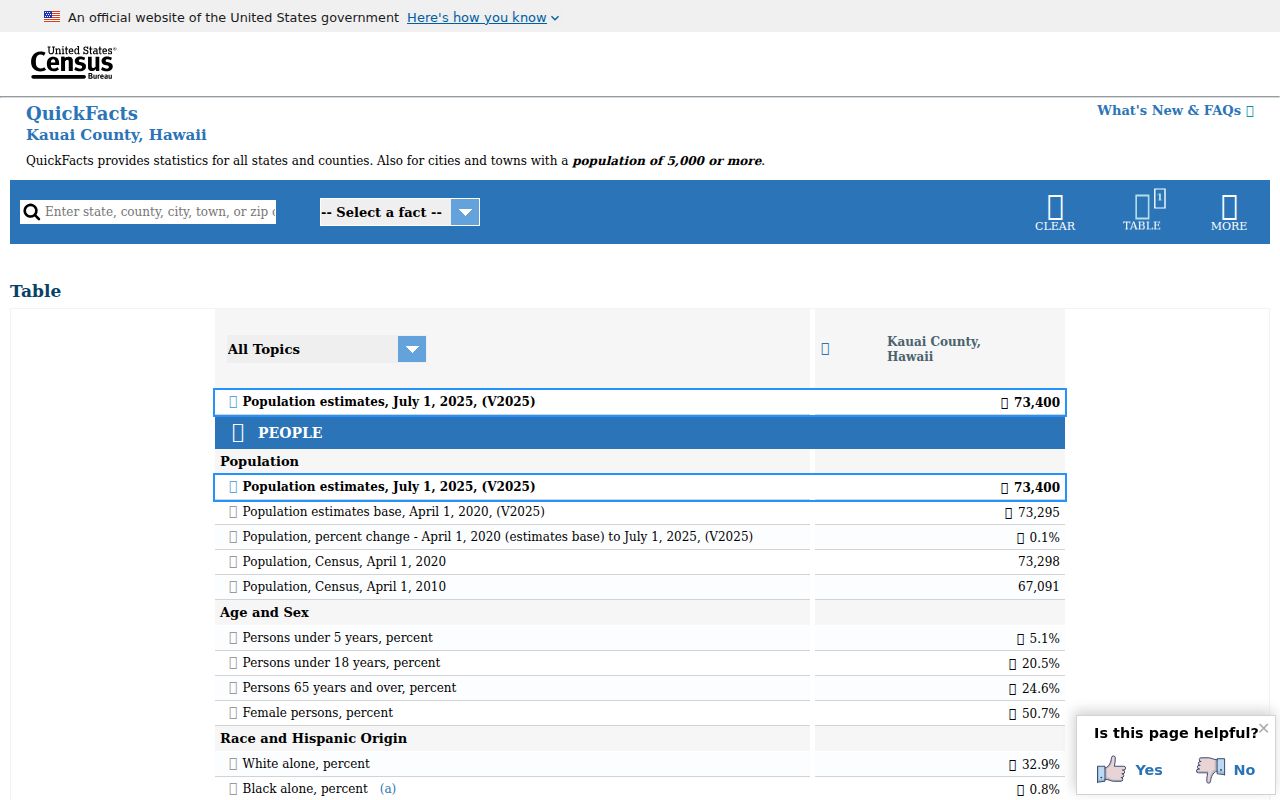
That distinction matters in criminal-record work: official identifiers and source documents carry more weight than geographic assumptions.